Workplace injury report form for employers in Canada
A free workplace injury report form for employers in Canada, in Word and PDF, with a filled example and when an injury must go to WSIB, WorkSafeBC or WCB.
This is a free workplace injury report form for employers in Canada: the internal report that a worker and their supervisor fill in on the day an employee is hurt or made ill at work. It records who was hurt, how, what first aid and treatment followed, and whether the worker has lost time or moved to modified work. Those last answers decide whether the injury also has to be reported to the provincial workers’ compensation board, so the form puts them where the person handling the report can see them. It comes as a two-page PDF to print and a Word file (.docx) to type into or change, which also opens in Google Docs and Pages.
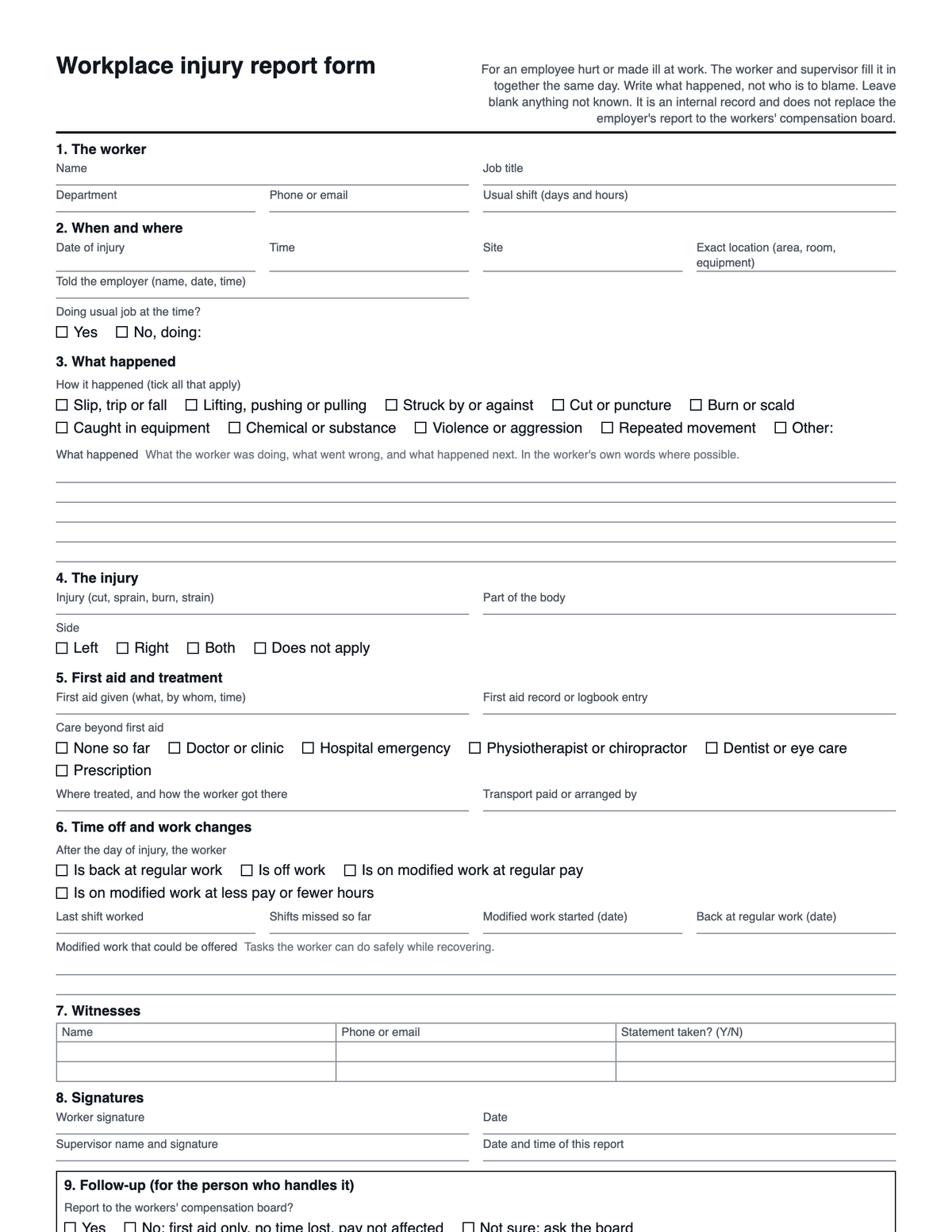
The form is an internal record. It is not the WSIB Form 7, the WorkSafeBC Form 7 or the Alberta employer report of injury, and it does not replace them. It collects the facts those reports ask for while they are fresh, so the board report takes minutes rather than a round of phone calls a week later.
Which form to use
Different incidents need different forms. Using the right one keeps each report short.
- An employee hurt or made ill at work: this form.
- A guest, visitor or resident hurt: the incident report form, or in a hotel the hotel guest incident report template, which asks for room numbers, check-out dates and video footage.
- Nobody hurt, but somebody could have been: the near miss report form.
- A coworker who saw it happen: the witness statement form, one per witness.
- Working out why it happened: the incident investigation form, which starts from this report.
How to fill in the form
Fill it in the same shift, with the worker if they are able. If the worker has gone for treatment, the supervisor starts the form and the worker reads, corrects and signs it on return. Write what was seen and said. Leave blank anything not known rather than guessing.
1. The worker. Name, job, department and a way to reach them. The usual shift matters later: a worker who missed a scheduled shift has lost time, and the board will ask about it.
2. When and where. The date, time and exact spot: the room number, the piece of equipment, the step. “Told the employer” records who heard about the injury, and when. In Ontario and Alberta the board’s deadline counts from when the employer learned of the injury, so this line starts the clock. Note whether the worker was doing their usual job, and if not, what they were doing.
3. What happened. Tick how it happened, then describe it in the worker’s own words where possible: what they were doing, what went wrong, and what happened next. “Lifted the mattress corner alone and felt a pull in the lower back” is useful. “Injured while working” is not. Keep opinions about fault out of it. The investigation is the place to work out causes.
4. The injury. What kind of injury, which part of the body, and which side. Be as specific as the worker can be: “right wrist”, not “arm”.
5. First aid and treatment. What first aid was given, by whom and when, and where it was recorded in the first aid log. Then any care beyond first aid: a doctor or clinic, hospital, a physiotherapist or chiropractor, a dentist or eye care, or a prescription. Note where the worker was treated, how they got there and who arranged or paid for the trip. This section usually decides whether the injury goes to the board.
6. Time off and work changes. What the worker is doing after the day of injury: back at regular work, off work, on modified work at regular pay, or on modified work at less pay or fewer hours. Add the last shift worked, shifts missed, and the dates modified work started and regular work resumed. These answers can change over the following days, so update them. The box for modified work that could be offered helps both the worker’s return and the board report, which in British Columbia asks for suggestions for transitional work.
7. Witnesses. Anyone who saw it, with a way to reach them, and whether a statement was taken. Use the witness statement form for each one, taken separately.
8. Signatures. The worker signs to confirm the account, and the supervisor signs with the date and time of the report.
9. Follow-up. The boxed part is for the person who handles injury claims: whether the injury goes to the board, when and how the report was sent, the claim number, when the worker was given a copy, who is investigating, and who closed the file.
A filled example
This is how a completed form reads. The people, hotel and details are invented.
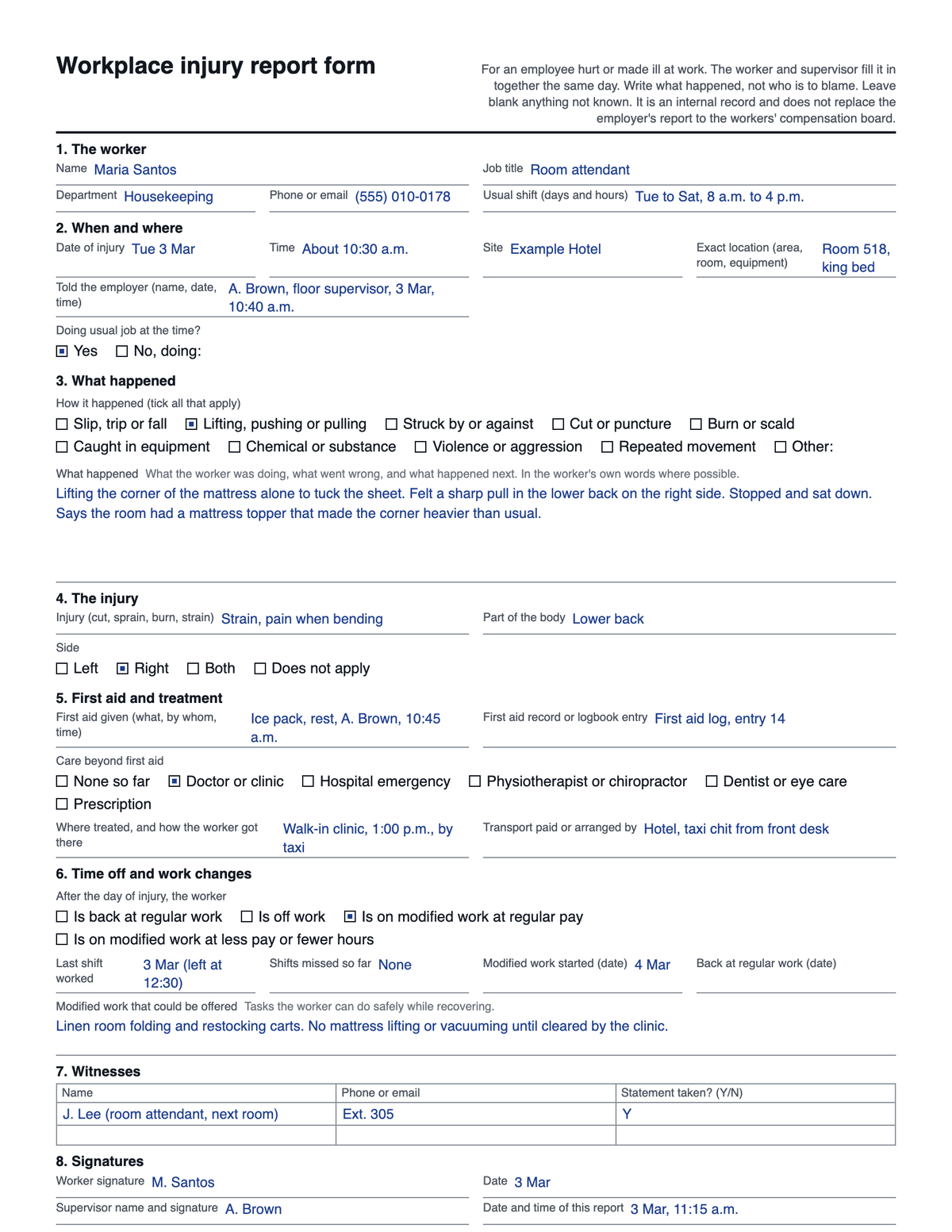
Two answers on this example matter for the board report. The worker saw a doctor at a clinic, which is health care beyond first aid. And she is on modified work, so the follow-up section needs a decision on reporting within days, not at the end of the month. In each of the three provinces below, treatment beyond first aid alone is enough to make the injury reportable.
When an injury must be reported to the workers’ compensation board
Each province and territory has its own workers’ compensation board with its own rules on what to report and how fast. The rules for Ontario, British Columbia and Alberta below come from each board’s own page, read on 2026-11-29. For other provinces and territories, the Association of Workers’ Compensation Boards of Canada (AWCBC) lists every board. Check the board’s page for any change before relying on this summary.
| Province | Board and report | Deadline | Report when the worker |
|---|---|---|---|
| Ontario | WSIB, Employer’s report of injury (Form 7) | Within three business days of learning of the injury | Needs treatment from a health professional, is absent from work, earns less than regular pay, needs modified work at less than regular pay, or needs modified work at regular pay for more than seven calendar days |
| British Columbia | WorkSafeBC, Form 7 Employer’s Report of Injury or Occupational Disease | Within 72 hours of the incident | Missed time from work, or needed medical attention beyond first aid in the workplace |
| Alberta | WCB Alberta, employer report of injury | Within 72 hours of becoming aware of the injury or illness | Has or is likely to have lost time or modified work beyond the date of accident, needs medical or mental health treatment beyond first aid, incurs medical aid expenses (such as dental treatment, eyeglass repair or prescriptions), or has a permanent disability, an occupational disease or a death |
A few more points from the same pages:
- Ontario. The WSIB says that if first aid was the only treatment received, the employer does not need to report to the WSIB, and that employers should provide first aid and keep accurate records of it. The employer must give the worker a copy of the report, pay a full day’s wage for the day of the injury, and, if the worker needs health care, either take them to the health professional or pay for their transportation that day. When the only reason to report is modified work at regular pay, the WSIB must receive the Form 7 within three business days of the eighth calendar day of modified work.
- British Columbia. Serious incidents and fatalities must be reported to WorkSafeBC immediately, by phone, in addition to the injury report. A report can go in before all the details are known. WorkSafeBC states that not reporting an injury is an offence under the Workers Compensation Act, and so is coercing a worker not to report one.
- Alberta. WCB Alberta asks for the report sooner rather than later, because the sooner it has the information, the faster it can decide on the worker’s benefits.
Workplace safety laws can set further duties for serious injuries, separate from the compensation board. Those duties also vary by province, and this form does not cover them. Check with the workplace safety regulator in each province where the organization operates.
First aid only: keep a record anyway
A cut cleaned and bandaged, an ice pack and twenty minutes of rest: many workplace injuries end with first aid. In Ontario these usually do not go to the WSIB, but the WSIB still tells employers to keep accurate records of first aid given. Fill in the form anyway, and file it with the first aid log entry.
There are three reasons. A small injury sometimes gets worse a few days later, and the worker then needs a doctor, at which point the injury becomes reportable and the original facts are needed. A pattern of small injuries at one task or one spot is a warning that a larger one is coming. And a record made at the time protects both the worker and the employer if the injury is questioned later.
After the report
- Report to the board if the rules call for it. Use the board’s online service or its form, within the deadline. Give the worker a copy where the board requires it.
- Plan modified work. Agree tasks the worker can do safely while recovering, in line with any limits from their health care provider. Write the start date on the form and update it when regular work resumes.
- Investigate. Every injury deserves a look at why it happened. For anything beyond a minor first aid case, use the incident investigation form, which walks through the five whys and a corrective action plan.
- Log it. Add a line to the incident log, so injuries can be counted by month, type and department, and overdue actions show up.
- Close it. Once the worker is back at regular work and the corrective actions are done, sign off the follow-up section with the date.
When a paper form stops being enough
A paper or Word form works for one site where a manager reads every report. It gets harder as the number of sites and reports grows. Forms sit in a tray until someone collects them, a three-day reporting deadline passes while the form is in a supervisor’s locker, and nobody can see which claims are still open without asking around.
Riskr starts from report form templates for injuries, property damage, security incidents and near misses, and custom forms can be built for anything else. Staff report on a phone at the scene or a computer afterwards, attach photos and files, and can save a draft to finish later. Every site uses the same forms, so reports can be compared side by side. Each report goes to the people responsible for following up, and gets an owner, a cause and a decision before it is closed. Riskr’s database is hosted in Canada, and the app works in English and French.
The form on this page stays free to use either way.