Hotel guest incident report template, with a filled example
A free hotel guest incident report form in Word and PDF, with a filled slip-and-fall example, what to add for the pool, spa and restaurant, and an FAQ.
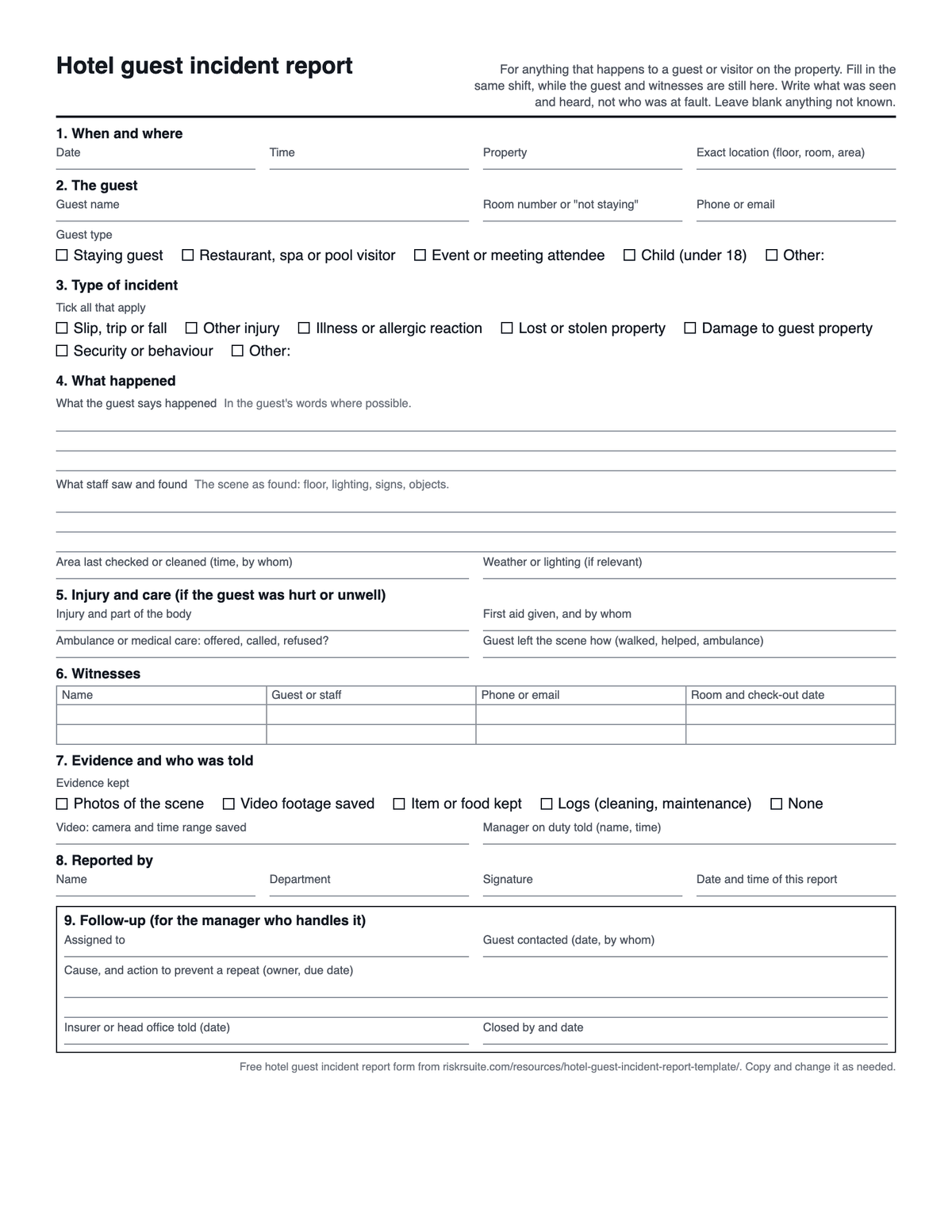
This is a free incident report form for anything that happens to a guest or visitor at a hotel or resort: a fall on the pool deck, an allergic reaction in the restaurant, a wallet missing from a room, a car scraped in the parking garage. It fits on one page. It comes in two versions with the same fields: a PDF to print, and a Word file (.docx) to type into or change, which also opens in Google Docs and Pages. Below the form is the same form filled in for a slip on a pool deck, what to add to it for each part of the hotel, and answers to the questions front desk and recreation staff ask most.
When to use this form, and when to use another
Use this form when the person hurt, unwell, upset or out of pocket is a guest or a visitor: a staying guest, someone using the restaurant, spa or pool, or someone at a wedding or meeting in the ballroom.
Use a different form in two cases:
- A staff member was hurt. Use the general incident report form. A staff injury starts a different follow-up: first aid, modified duties and, often, a workers’ compensation claim. These duties are set by each province and territory, and they differ. The AWCBC lists the board for each one, from WorkSafeBC to the WSIB in Ontario and the CNESST in Quebec. If a guest and an employee were both hurt in the same event, fill in one form for each and note the other form on both.
- Nobody was hurt and nothing was lost or damaged. A guest who nearly slipped, a pool gate found propped open: use the near miss report form. It takes a minute, and it is where most falls can be stopped before they happen.
What each part of the form is for
The form follows the order in which things happen at the scene: look after the guest, record what is there before it changes, then hand over.
When and where. The exact spot, not only “pool” or “lobby”. “Pool deck, by the shallow-end steps” tells maintenance where to look, and it lets a manager see later whether falls keep happening at the same place.
The guest. Name, room number and one way to reach them. Tick “Child” when the guest is under 18, and note the parent or guardian in the account. This section asks only for what the follow-up needs. There is no line for a home address, a date of birth or a copy of ID. The privacy section below explains why.
Type of incident. Tick all that apply. A fall that breaks a guest’s phone is both a fall and damage to guest property.
What happened, in two parts. This is the part that makes a guest form different from a staff form. The guest’s account and what staff saw are kept apart:
- What the guest says happened. In the guest’s words where possible, including anything the guest says about the cause (“there was no sign”). Write it down without arguing or agreeing.
- What staff saw and found. The scene as the employee found it: water, ice, lighting, signs, mats, objects on the floor, footwear. This is the record that answers the questions asked weeks later, when a guest’s lawyer or the hotel’s insurer asks what the floor was like.
Then record when the area was last checked or cleaned, and by whom. CCOHS names wet or oily surfaces, spills, weather and loose mats among the common causes of slips. The time of the last check is often the most useful line on the form, because it shows whether the hazard was there for two minutes or two hours.
Injury and care. What hurts and where, the first aid given and by whom, and whether medical care or an ambulance was offered, called or turned down. Write down a refusal plainly, with the time: “Ambulance offered 7:50 a.m., guest declined.” Note how the guest left the scene.
Witnesses. Hotel witnesses check out. That is why the form asks for each witness’s room and check-out date next to a phone number or email. A witness who leaves tomorrow should be asked for a short account today.
Evidence and who was told. Photos of the scene before it is cleaned up, with something in the frame for scale. Many camera systems record over old footage after a set number of days, so write down the camera and the time range saved, and ask whoever runs the system to keep it. Keep any item involved: the broken chair, the dish that caused the reaction, the packaging. Note the manager on duty who was told, and when.
Reported by. The employee who filled in the form, their department, and when the report was written. A report written at 8:20 a.m. about a fall at 7:40 a.m. carries more weight than one written at the end of the week.
Follow-up. The boxed section at the bottom is for the manager who takes the report. Who owns it, when the guest was contacted, the cause and the action that stops a repeat, whether the insurer or head office was told, and when it was closed. In the Word version, this section starts on a second page so the front-line part prints on one sheet.
A filled example: a slip on the pool deck
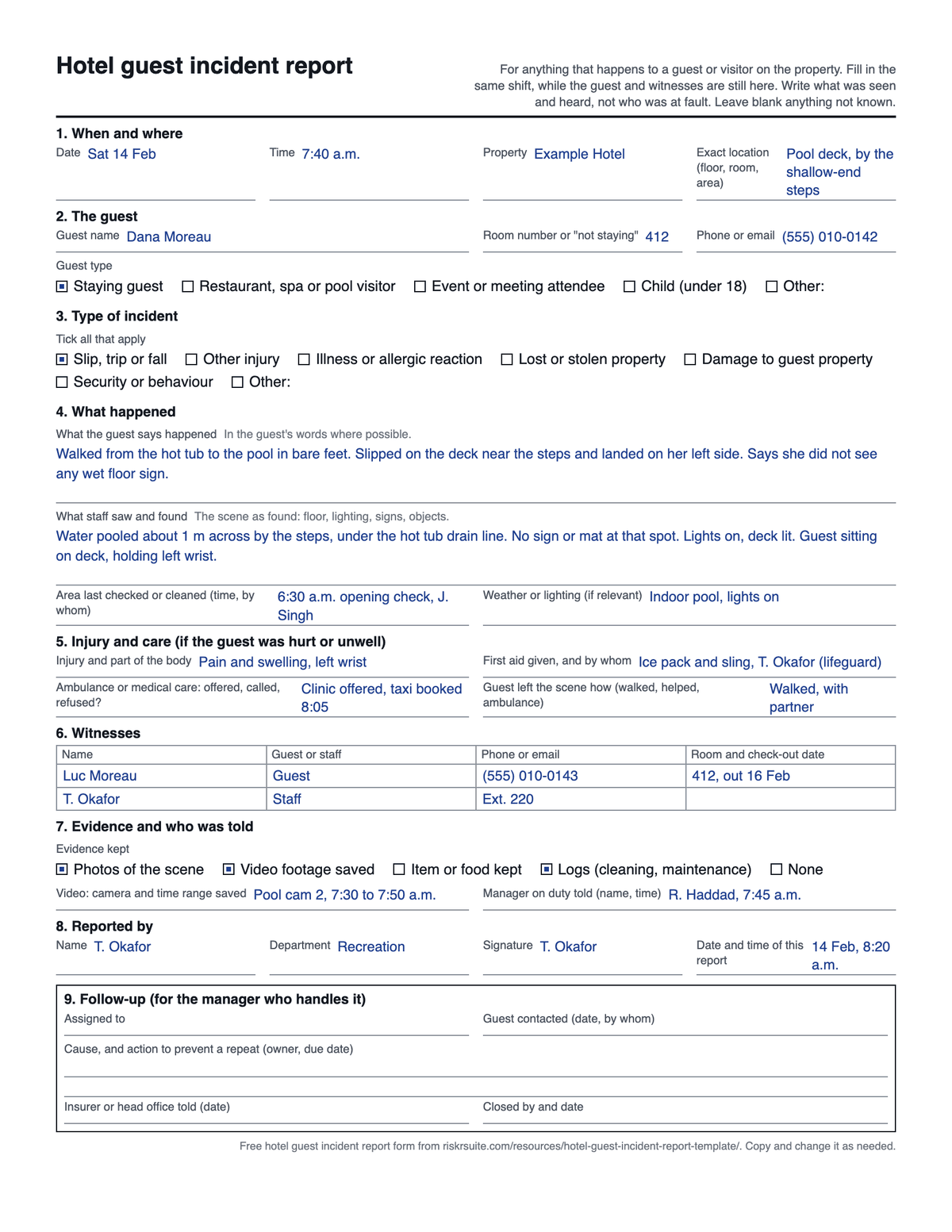
The example below is invented. A guest walks from the hot tub to the pool at 7:40 on a Saturday morning, slips by the steps and hurts her wrist. The lifeguard fills in the form.
What makes this report useful:
- The guest’s account and the scene are separate. The guest says there was no sign. The lifeguard records what was there: water pooled about a metre across, under the hot tub drain line, with no sign or mat at that spot. Neither line says whose fault it was.
- The last check is recorded. The deck was checked at 6:30 a.m., about an hour before the fall. That points the follow-up at the drain line and the round, not at the guest.
- Care is on the record. First aid, the clinic offered and the taxi booked are written down with times.
- The witness can be reached after check-out. The guest’s partner leaves on the 16th, and his phone number is on the form.
- Evidence was kept before it was lost. Photos, the camera and the 20 minutes of footage, and the cleaning log.
The manager who takes the report fills in the follow-up. In this example, the cause is a leaking drain line that leaves water in one spot, and the opening check missed it because the leak starts when the hot tub heats up. The actions: maintenance repairs the line this week, a secured mat goes down at the steps today, and the hourly pool round adds a look at the hot tub side. These follow CCOHS’s order for preventing slips and trips: good housekeeping first, including cleaning and marking spills and wet areas and securing mats that do not lie flat, then changes to the floor itself. For a structured way to find the cause, the incident investigation form walks through the five whys.
What to add for each part of the hotel
The same form works across the property. A few extra lines in the “What happened” boxes make each report complete.
| Area | Add to the report |
|---|---|
| Pool and hot tub | Lifeguard on duty or not; where the guest entered and left the water; deck condition; footwear; whether the area was staffed or self-serve at the time. |
| Spa and fitness room | The treatment or machine; the therapist or attendant; products used; anything the guest disclosed on the spa’s intake form that relates to the incident. |
| Restaurant and bar | What the guest ate or drank and when; any allergy the guest mentioned before ordering, and to whom; keep the dish, the packaging or the label. Duties to report a suspected food-borne illness differ by province; ask the local public health unit. |
| Front desk and lobby | For lost or stolen property: what the item is, when and where the guest last had it, and whether the room’s key card entries were checked. Note the floor and weather at the entrance for falls. |
| Guest rooms | The room number and what failed: a bathtub, a balcony door, a bed frame, a hair dryer. Take the item out of the room and tag it so it is not put back. |
| Parking and grounds | Vehicle plate and damage for parking incidents; snow, ice and salting time for falls outside; lighting at night. |
| Events and meetings | The event name and organizer; the room setup; who from the event was told. |
A hotel that adds the same lines every time should change its copy of the form. The Word version is built for that.
Talking to the guest
The person filling in the form is often the first employee the guest talks to after something goes wrong. A few habits keep the report accurate and the guest looked after:
- Care first, form second. Offer first aid and medical care before asking questions. The form can wait ten minutes. Some details cannot: take photos before the spill is mopped.
- Ask, then write what was said. “What happened?” and “Where does it hurt?” Write the answers down as given. Do not suggest causes.
- Stick to facts and care. Leave questions of fault, cost and compensation to the manager and the insurer. Saying “a manager will call tomorrow” and giving their name is better than a promise the hotel cannot keep.
- Explain what the information is for. The guest’s contact details are so a manager can follow up. Say so.
Guest privacy
An incident report holds personal information: a guest’s name, room number, contact details and often something about their health. The Office of the Privacy Commissioner of Canada’s principle on limiting collection says organizations should collect only the personal information they need to fulfill a legitimate identified purpose, and limit the amount and type to what is needed. In practice, for this form:
- Ask only for what the follow-up needs. A name, room and one way to reach the guest are enough. A home address or a copy of a driver’s licence is not needed to report a fall.
- Record health details that relate to the incident (“pain in left wrist”), not the guest’s medical history.
- Keep completed forms where only the people who handle them can read them, not in a tray at the front desk.
The hotel incident reporting guide covers which privacy law applies in which province.
FAQ
Does the guest have to sign the form? No. The form is the hotel’s internal record, written by an employee. Some hotels ask the guest to read and sign their own account. If a guest prefers to write their account themselves, attach it to the form.
Should the guest get a copy? Decide this as a policy, with the insurer, before it comes up at the front desk at midnight. Front-line staff should know the answer, and who to refer the guest to.
What if the guest refuses help or will not give details? Fill in the form anyway with what is known. Write down what was offered, when, and that it was declined. A report with gaps is better than no report.
Can the form be filled in after the guest has left? Yes, but as early as possible, and the same shift whenever possible. Note the time the report was written. Details fade within hours, and witnesses check out.
How long should completed forms be kept? That depends on the province and on the hotel’s insurer and lawyer. Ask them, and keep every report until there is an answer.
Is this form enough for a hotel group? For one property with a few guest incidents a month, a paper or Word form works. It gets harder with several properties: reports wait in trays, follow-up depends on memory, each property edits its own copy, and counting falls at one entrance means reading binders. See the next section.
When a paper form stops being enough
Riskr is incident reporting software that gives staff the same report forms at every site, on a phone at the scene or a computer afterwards, with photos and files attached and a draft that can be finished later. When a report is submitted, it goes to the people responsible for following up. Each incident gets an owner, a cause and a decision, and corrective actions have an owner and a due date. Every site answers the same questions, so reports can be compared across properties. Riskr’s database is hosted in Canada, and the whole app works in English and French, including the organization’s own forms.
The form on this page stays free to use either way. Copy it, change it, and put it where incidents get reported.