Incident investigation form, with a five whys template and corrective actions
A free incident investigation form in Word and PDF, with a five whys section, cause categories, a corrective action plan and how to run each step.
This is a free incident investigation form for the step after an incident is reported: working out why it happened and what will stop it happening again. It is written for places where guests, residents and staff share the same spaces, such as hotels, pools and spas, restaurant kitchens, ski areas, attractions, senior living residences and event venues, but the steps are the same anywhere. It covers the facts, the people involved, a five whys analysis, contributing factors, a corrective action plan and sign-off, on two pages. It comes as a PDF to print and a Word file (.docx) to type into or change, which also opens in Google Docs and Pages. Together, the completed pages make the investigation report.
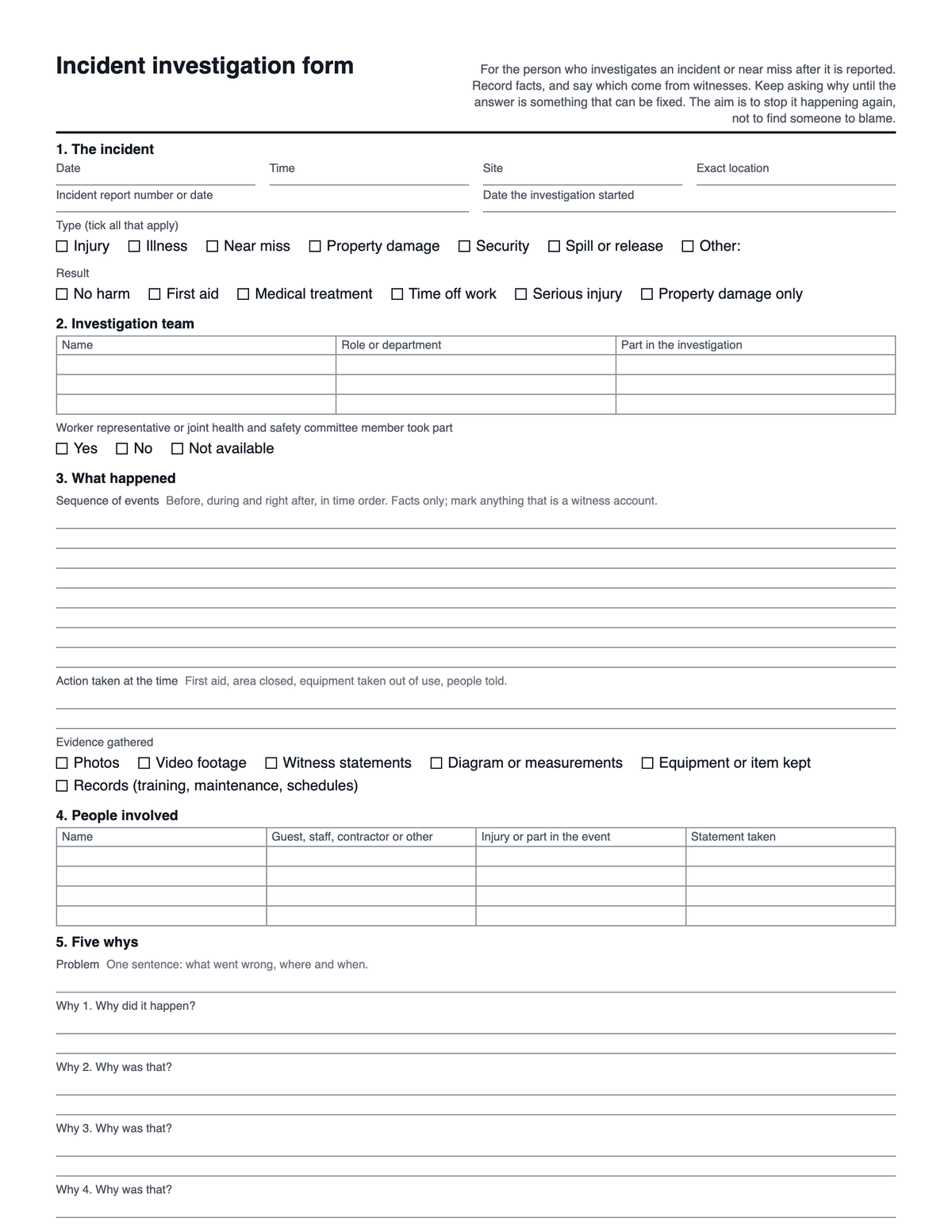
The investigation form does not replace the first report. The person who saw or was involved in the incident fills in an incident report form the same day, or a near miss report form if nobody was hurt and nothing was damaged. The investigation starts from that report.
When to investigate an incident
Every incident gets a follow-up, but not every one needs this full form. A spilled drink that was mopped up in a minute needs a line in the log. A fall that sent a guest to hospital, or a near miss that could have, needs an investigation.
The Canadian Centre for Occupational Health and Safety (CCOHS) calls it good practice to investigate incidents that caused no injury or damage as well as those that did. Near misses come from the same hazards as injuries, and they are cheaper to learn from. A useful rule is to investigate by the worst likely result, not only the actual one. A box that fell from a high shelf and missed a cook deserves the same look as the box that hit someone.
Some investigations are also required by law. In British Columbia, WorkSafeBC says employers must immediately investigate incidents that cause serious injury or death to a worker, injuries that need medical treatment, and incidents with minor or no injury that “had the potential for causing serious injury”, among others. Other provinces set their own rules on what must be investigated, by whom and how quickly. See “The investigation report” below.
Who should investigate
CCOHS suggests a small team rather than one person, and lists who can be on it: workers who know the work, the supervisor of the area, and a member of the health and safety committee or the worker representative. People experienced in investigation techniques help too.
The supervisor usually knows the work best, but CCOHS notes the risk that an investigation led by the supervisor may gloss over the supervisor’s own part in what happened. A second person from outside the department helps. In British Columbia, WorkSafeBC requires that the people investigating know the type of work involved, and that an employer representative and a worker representative take part if they are available. The form records who was on the team and whether a worker representative or committee member took part.
Keep the team small enough to move quickly. For most incidents at one site, two or three people are enough: the head of the area, someone who does the work, and someone from the safety committee.
The steps of an incident investigation
CCOHS sets out the steps an investigation team follows. In practice they look like this:
- Make the scene safe and keep it as it is. Deal with the injured person and any hazard still there first. Then leave things where they are until they have been photographed and measured, if that is safe.
- Gather the facts. Photos, video footage, the equipment or item involved, the first report, and records such as training, maintenance logs, cleaning checklists and the staff schedule for that shift. Note on the form what was gathered and where it is kept.
- Talk to the people involved and the witnesses. One at a time, as soon as possible, somewhere quiet. Ask what they saw and heard, in their own words. Guests and contractors may be gone the next day, so their details come first.
- Write down what happened, in order. Before, during and right after the incident. CCOHS asks investigators to make clear which parts come from facts and which from witness accounts or the team’s own assumptions.
- Find the causes. The five whys section below is one way. CCOHS lists other root cause methods, such as brainstorming and fault tree analysis, and says there is no single right way to do it.
- Decide on corrective actions. Each one specific, with an owner and a due date.
- Report, act and follow up. Share the findings, put the actions in place, and check weeks later that they are working.
CCOHS puts the purpose of the whole exercise as “to find facts that can lead to corrective actions, not to find fault.” If staff believe an investigation is a search for someone to blame, they stop reporting and stop talking, and the next investigation has less to work with.
How to use the five whys
The five whys is a simple way to get from what happened to why it happened. CCOHS describes it as a technique where the investigator asks “why” five or more times. Each answer becomes the next question, until the answer is something the organization can change.
Start with a one-line problem statement: what went wrong, where and when. Then ask why. This example is invented:
- Problem: A line cook burned a forearm on hot oil while emptying a fryer at closing on Sunday night.
- Why 1. Why did it happen? Oil splashed out of the container as it was being filled from the fryer drain.
- Why 2. Why was that? The container was too small for a full fryer, and it was sitting on the floor, so the oil fell a long way and splashed.
- Why 3. Why was that? The usual oil caddy with a lid and a long hose was out of service with a broken wheel, so staff used a stock pot instead.
- Why 4. Why was that? The caddy had been broken for two weeks. It was reported verbally to the kitchen manager, but nothing was logged.
- Why 5. Why was that? The kitchen has no way to report broken equipment that is tracked until it is fixed, and no rule on what to do when the caddy is out of service.
- Root causes: No system for reporting and fixing broken kitchen equipment, and no safe fallback for draining fryers.
The first answer (“oil splashed”) describes the event. The fifth describes something that can be fixed, and fixing it prevents other incidents that have nothing to do with fryers.
A few things go wrong with the five whys:
- Stopping at a person. “The cook was careless” is not a root cause. OSHA warns that it is far too easy, and often misleading, to conclude that carelessness caused an incident. When the answer is about a person, ask why again: why was the safe way not used, or not possible?
- Following only one chain. CCOHS notes that there is seldom, if ever, only one cause. In the example, the missing fallback procedure and the untracked repair are separate causes, and each needs its own fix. If one “why” has two answers, follow both.
- Stopping at exactly five. Five is a guide, not a rule. Stop when the answer is something that can be changed, whether that takes three whys or seven.
- Guessing. Each answer should come from the facts gathered, not from what the team assumes. If nobody knows why, find out before writing it down.
Contributing factors
The five whys finds the main chain of causes. The contributing factors section is a check for anything it missed. CCOHS groups the causes of any incident into five categories, and the form lists them as ticks:
- Task: whether a safe procedure existed, was clear, and was followed. If not, why not?
- Material: equipment, tools, materials and protective gear. Was something broken, missing or the wrong kind?
- Environment: the physical conditions, such as floors, lighting, noise, weather and layout.
- Personnel: training, experience, fatigue and staffing. Was the person trained for this task, and was the shift short-staffed?
- Management: supervision, inspections, maintenance and how earlier reports were handled.
In the fryer example, four of the five apply: no procedure for draining without the caddy (task), the broken caddy (material), the floor-level container (environment), and the repair that was never tracked (management). Each points to a different fix.
Corrective actions that work
A corrective action is what will be done so the same thing does not happen again. CCOHS asks for recommendations that are specific and constructive and that address the root causes and contributing factors, and it warns against making only general recommendations to save time. “Be more careful” and “retrain staff” are not corrective actions on their own. “Replace the caddy wheel and keep a spare caddy on site” is.
When choosing actions, start with the strongest kind. CCOHS describes a hierarchy of controls, ranked from most effective to least: removing the hazard, replacing it with something less hazardous, engineering controls that deal with the hazard at its source, administrative controls such as procedures and training, and protective gear. The form’s “Type” column uses the same order: remove, replace, guard, procedure, gear. A team that writes only procedures and gear has usually stopped short.
For the fryer example, the corrective actions might be:
| Action | Type | Owner | Due |
|---|---|---|---|
| Repair the oil caddy and buy a second one | Replace | Kitchen manager | This week |
| Add broken equipment to the maintenance log, with a target fix date | Procedure | Executive chef | Two weeks |
| Write a rule: if no caddy is available, the fryer is not drained until one is | Procedure | Executive chef | This week |
| Issue long gloves and a face shield at the fryer station | Gear | Kitchen manager | This week |
The names, roles and dates are invented. Every action has an owner and a due date, and none of them is about disciplining the cook. CCOHS advises never making recommendations about disciplining anyone who may be at fault, because the aim is to fix the conditions that made the incident possible.
The investigation report
The completed form is the investigation report. CCOHS says a good report includes all relevant details, including photographs and diagrams, and that the measure of a good report is quality, not quantity. Attach the photos, statements and diagrams the form lists, and share the findings with the staff, supervisors and managers who need them. Management is responsible for acting on the recommendations, assigning each action to a person and checking that it is done.
Some jurisdictions also set what the report must contain and when it is due. WorkSafeBC says an employer must complete a preliminary investigation and report within 48 hours of an incident, and a full investigation and report within 30 days. The full report states what the investigation found to be the cause or causes. After it, the employer prepares a corrective action report covering the unsafe conditions, acts or procedures that made action necessary, the actions taken, the names and job titles of the people responsible for them, and the date each is completed. A copy goes to the joint health and safety committee or the worker health and safety representative.
Other provinces and territories set their own rules on which incidents must be investigated and reported, by whom and how quickly, and this form does not cover them. Check with the workers’ compensation board and the workplace safety regulator in each province where the organization operates. The AWCBC lists the board for every province and territory. Incidents involving guests or residents rather than staff may have their own reporting rules in some sectors; check with the regulator for the sector. The form has a line to record any report made to a regulator or board.
What each part of the form is for
The incident. When and where, and a reference to the original report so the two stay together. The type and result ticks let investigations be counted and compared later.
Investigation team. Who investigated and what each person did, and whether a worker representative or committee member took part.
What happened. The sequence of events gets the most space. Write it in time order, and mark anything that comes from a witness rather than from evidence. The evidence ticks are a checklist as much as a record: if no one has pulled the maintenance log yet, the tick box is a reminder.
People involved. Everyone who was hurt, involved or saw it, and whether their statement was taken.
Five whys and contributing factors. The analysis. The root cause box is the one the corrective actions must answer.
Corrective actions. Each action on its own line, with its type, an owner, a due date and the date it was done.
Sign-off and follow-up. Who investigated, who reviewed it, who it was shared with, and a follow-up check some weeks later. CCOHS suggests checking that scheduled actions are completed; the follow-up line is also where to note whether an action is working or needs changing. An investigation is closed when its actions are done and checked, not when the form is filed.
When a paper form stops being enough
A paper or Word form works for a single site where one manager runs every investigation. It gets harder with more sites and more incidents. Forms sit in a folder until someone remembers them. Corrective actions are written down and never checked. Nobody can see which investigations are still open, or that the same broken equipment has caused incidents at three properties.
Riskr gives every incident an owner, a cause and a decision. Each corrective action has an owner and a due date, and stays open until it is done, and every step is logged, from the first report to the final decision. A closed incident is added to the history of the risk it belongs to, so over time that history shows which risks keep happening. Riskr’s database is hosted in Canada, and the app works in English and French.
The form on this page stays free to use either way. The causes found in investigations are also good entries for a risk register.
Sources
- Canadian Centre for Occupational Health and Safety (CCOHS), Incident Investigation
- Canadian Centre for Occupational Health and Safety (CCOHS), Hierarchy of Controls
- Occupational Safety and Health Administration (OSHA), Incident Investigation
- WorkSafeBC, Conducting an employer investigation
- Association of Workers' Compensation Boards of Canada (AWCBC), Our Members