Near miss report form, with examples and what to do with each report
A free near miss report form in Word and PDF, with what counts as a near miss, examples from hotels, pools and kitchens, and how to act on each report.
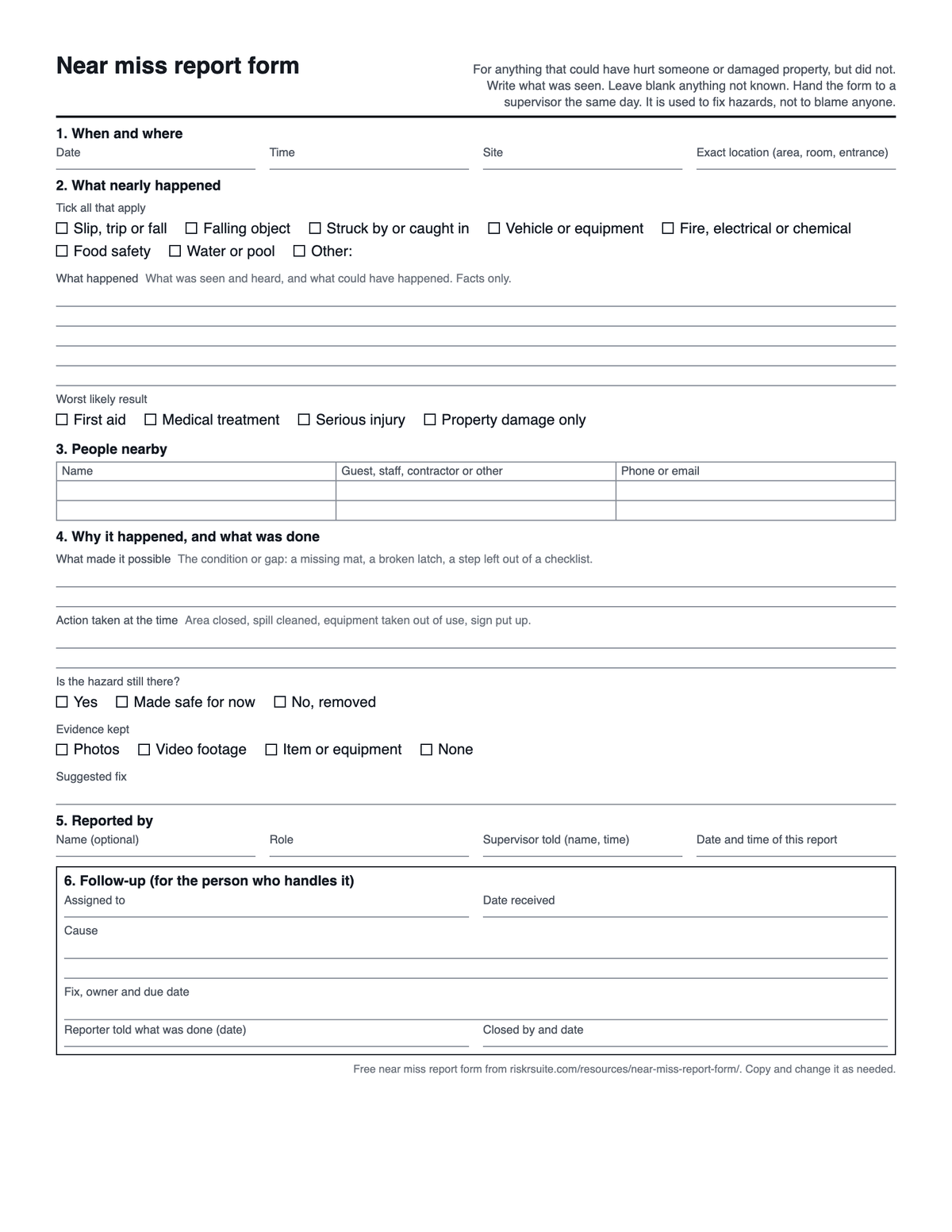
This is a free near miss report form for places where guests and staff share the same spaces: hotels, pools and spas, restaurant kitchens, ski areas, attractions, senior living residences and event venues. It fits on one page and asks only what the person who handles the report needs to fix the hazard. It comes in two versions with the same fields: a PDF to print, and a Word file (.docx) to type into or change, which also opens in Google Docs and Pages.
For an incident where someone was hurt or property was damaged, use the incident report form instead. It has room for injuries, first aid and witness statements, which a near miss report does not need.
What is a near miss?
A near miss is an event that could have hurt someone or damaged property, but did not. A guest steps on a wet tile and catches the rail. A box falls from a high shelf in the storeroom a second after a cook walks past. A pool gate is found propped open before the lifeguard is on duty. Nobody was hurt, and nothing was broken, but the next time it might be.
The Canadian Centre for Occupational Health and Safety (CCOHS) names the same idea in its guide to incident investigation: “near miss” or “dangerous occurrence” are terms “for an event that could have caused harm but did not”. Its page on reporting adds two more names, “near-hit” and “no-loss”. In the United States, OSHA calls them close calls, “in which a worker might have been hurt if the circumstances had been slightly different.”
Three words often get mixed up:
- A hazard is a condition that could cause harm: a frayed cord, a loose stair nosing, an unlabelled bottle of cleaner. Nothing has happened yet.
- A near miss is an event where a hazard nearly caused harm: someone trips on the frayed cord and does not fall.
- An incident, in the narrow sense, is an event where harm was done: someone trips on the cord and breaks a wrist.
Many organizations use “incident” for both near misses and events that caused harm, and CCOHS does too. The difference that matters for the form is simple. If someone was hurt or something was damaged, use an incident report. If not, use this form. If staff are unsure, either form is better than no report.
Near miss examples
Near misses look different in each part of an operation. These examples show what staff should be reporting. Every one of them is easy to fix before someone is hurt, and expensive after.
Hotels and resorts
- A housekeeper’s cart rolls when its brake fails on the sloped corridor to the service elevator.
- A guest slips on the lobby floor during mopping, catches the front desk, and walks away.
- A balcony door in a guest room is found with a broken lock on a high floor.
- A fire exit on the service stairs is blocked by stacked linen.
Pools, spas and fitness rooms
- A child is found in the pool area with no adult while the gate latch is broken.
- A sauna heater guard is found loose during the evening check.
- A dumbbell rolls off a rack onto the floor beside a guest.
- Pool chemicals are found stored next to each other in the pump room against the supplier’s instructions.
Restaurant kitchens
- A line cook slips on oil near the fryer and stops the fall on the counter.
- A knife left under a cloth on the prep table is found by hand.
- A walk-in cooler door will not open from the inside.
- A container of cleaner is found in an unlabelled water bottle on the dish line.
Ski areas, attractions and venues
- A chairlift bar is lowered onto a guest who has not sat back yet, and is raised again in time.
- A crowd barrier at an event entrance tips over before doors open.
- A golf cart or snowmobile takes a blind corner where staff walk.
Senior living
- A resident is found standing up from a wheelchair whose brakes were not set.
- A call bell in a bathroom is found out of reach, tied up behind the rail.
- A medication cart is found unlocked in a hallway.
None of these hurt anyone, so none would show up in an injury report. That is the point of reporting them.
Why near miss reporting matters
Injury reports look backward. They count harm that has already happened. Near misses show the same hazards earlier, when the fix is a mat, a new latch or a line on a checklist instead of a claim.
CCOHS calls it good practice to report and investigate incidents that cause no injury or damage. It says these reports are an opportunity to find what to improve, and that reporting them “will help prevent a similar incident from reoccurring.” OSHA likewise encourages employers to investigate close calls as well as incidents where a worker was hurt.
There is also a counting reason. CCOHS warns that an employer who sees a low rate of lost-time injuries over six months may conclude there is no safety issue, when there may have been twice as many near misses over the same period. A site with no injuries and no near miss reports is not necessarily safe. It may simply not be reporting.
For operators whose guests and residents are on site, near misses also cover the public: the slip in the lobby, the unattended pool gate, the resident who nearly fell. Those are the incidents that turn into complaints and claims when they are not caught early.
What each part of the form is for
The form is short on purpose. A near miss report has to be quicker to fill in than to skip, or it will not get filled in.
When and where. The date, time, site and exact spot. “Pool deck, shower exit” helps. “Pool” does not. The exact location is what shows that the same exit has had four near misses this season.
What nearly happened. A few ticks for the kind of hazard, so reports can be sorted and counted, then a box for what was seen and heard and what could have happened. Ask for facts, not blame. The last line asks for the worst likely result: first aid, medical treatment, serious injury, or property damage only. That one tick tells the person handling the report how fast to act.
People nearby. Who was there, if anyone, and how to reach them. A guest or contractor who saw it may be gone by the next day.
Why it happened, and what was done. The condition that made it possible, such as a missing mat or a broken latch, and what the reporter did on the spot. Whether the hazard is still there is the question a supervisor needs answered first. Note any photos or video, and where they are kept. The last box asks the reporter for a fix. Staff who work in the area often know exactly what would stop it happening again.
Reported by. The name is optional. Some staff will report only if they can leave their name off, and an unsigned report is better than none. The supervisor’s name and the time show who knew, and when.
Follow-up. The boxed part is for the person who handles the report: who it was assigned to, the cause, the fix with an owner and a due date, the date the reporter was told what was done, and who closed it. The Word version puts this part on a second page, so the reporter’s part prints on one sheet.
A filled example
This is how a completed report reads. The details are invented.
- When and where: Saturday, 7:40 a.m., main building, indoor pool, shower exit to the deck.
- What nearly happened: Slip, trip or fall. “Guest in sandals slipped on water at the shower exit and grabbed the door frame. Did not fall. The non-slip mat at the exit was not there. Floor was wet across the doorway.”
- Worst likely result: Serious injury (fall onto tile beside the pool).
- People nearby: Guest, adult, staying in the hotel; declined to give a name. Lifeguard on duty.
- What made it possible: The mat is taken up for overnight cleaning and was not put back before opening.
- Action taken at the time: Floor dried, wet floor sign put up, spare mat brought from the spa.
- Hazard still there: Made safe for now. Evidence: Photos, on the pool office tablet.
- Suggested fix: Add “mat back in place” to the opening checklist.
- Follow-up: Assigned to the aquatics supervisor. Cause: the overnight cleaning list has no step to replace the mat. Fix: step added to the cleaning and opening checklists, owner aquatics supervisor, due Monday. Reporter told on Monday. Closed Tuesday.
The report took a few minutes to write. The fix cost nothing. The same slip with a fall onto tile would have meant first aid, an incident report, a call to the guest and possibly an insurer.
Getting staff to report near misses
Most near misses go unreported because reporting seems like more trouble than it is worth, or because staff worry it will get someone in trouble. These habits change that:
- Make it about fixing, not fault. CCOHS puts the purpose of an investigation as “to find facts that can lead to corrective actions, not to find fault.” Say so on the form and mean it. A report that leads to someone being disciplined will be the last one for a while.
- Keep it short. If the near miss form is as long as an injury report, staff will not use it. One page, mostly ticks.
- Put forms where the work is. The housekeeping office, the kitchen pass, the pool office, the lift hut, the nursing station. Not the general manager’s office.
- Tell the reporter what happened. The form has a line for the date the reporter was told what was done. Nothing builds reporting faster than seeing a fix. Nothing stops it faster than silence.
- Thank people in public. Mention good catches at the shift briefing. A near miss report is a good thing to have, not a mark against a department.
- Count reports as a good sign. A department that files ten near miss reports a month is usually paying attention, not failing.
What to do after a near miss is reported
A near miss report needs the same four steps as any incident report, scaled to how bad it could have been.
- Make it safe. If the hazard is still there, deal with it first: close the area, take the equipment out of use, put up a sign.
- Assign it. One person owns the follow-up, usually the head of the area where it happened. Write their name and the date on the form.
- Find the cause and fix it. Ask why it happened, then ask why again, until the answer is something that can be changed: a step missing from a checklist, a part that needs replacing, a schedule that leaves the pool unstaffed. Use the “worst likely result” tick to decide how much effort to spend. A near miss that could have caused a serious injury deserves the same look as an actual injury. For those, use the incident investigation form, which walks through the five whys and a corrective action plan.
- Close it and tell the reporter. Once the fix is in place, the owner signs it off with the date, and the person who reported it is told what was done.
Some near misses also have legal duties attached. In British Columbia, WorkSafeBC lists an incident that caused a “minor injury, or no injury, but had the potential for causing serious injury” among those an employer must investigate. It says the employer must complete a preliminary investigation and report within 48 hours, and a full investigation and report within 30 days. Rules elsewhere differ in what must be investigated and reported, by whom and how quickly, and this form does not cover them. Check with the workers’ compensation board and the workplace safety regulator in each province where the organization operates. The AWCBC lists the board for every province and territory.
Near misses that affect guests or residents, rather than staff, may have their own reporting rules in some sectors. Check with the regulator for the sector.
When a paper form stops being enough
A paper or Word form works for one site where a manager reads every report. It gets harder as the number of sites and reports grows. Forms sit in a tray until someone collects them. Nobody can see which reports are still open. Photos stay on someone’s phone. Counting near misses at one pool exit, or across five properties, means reading through binders by hand. And the reporter is rarely told what happened, so the reports slow down.
Riskr has a near miss form of its own, kept to two questions to encourage reporting, next to forms for injuries, property damage and security incidents. Staff report on a phone at the scene or a computer afterwards, attach photos and files, and can save a draft to finish later. Every site uses the same forms, so reports can be compared side by side. Each report goes to the people responsible for following up, and gets an owner, a cause and a decision before it is closed. Riskr’s database is hosted in Canada, and the app works in English and French.
The form on this page stays free to use either way. For more on choosing software for a hotel, see what to look for in hotel incident reporting software. Near misses are also a good source of entries for a risk register.
Sources
- Canadian Centre for Occupational Health and Safety (CCOHS), Incident Investigation
- Canadian Centre for Occupational Health and Safety (CCOHS), Hazard and Near-Miss Reporting by Workers
- Canadian Centre for Occupational Health and Safety (CCOHS), Leading and Lagging Indicators
- Occupational Safety and Health Administration (OSHA), Incident Investigation
- WorkSafeBC, Conducting an employer investigation
- Association of Workers' Compensation Boards of Canada (AWCBC), Our Members